
You rip a pack. Your hands go cold. There it is: a shiny rookie staring back at you like it knows something you don’t. Your brain does three things in order: scream, grab a top loader, and whisper the most expensive question in the hobby: “Should I grade this?”
Great question. The honest answer is “sometimes,” and guessing wrong on that “sometimes” costs real money. This guide covers how to grade sports cards, how PSA, BGS, and SGC actually differ, and the part every collector wants to know the second a hit lands: which cards you pull from wax are worth grading, and which should stay raw.
The short version: Grade a card when the price gap between a high grade and the raw card is bigger than the total cost of grading, and the card genuinely looks clean under a bright light. PSA is the resale king, BGS is the show-your-work grader with subgrades, and SGC is the fast, value-friendly pick with vintage roots. Most of what’s in a typical box is better off raw.
What Card Grading Actually Is (In Plain English)
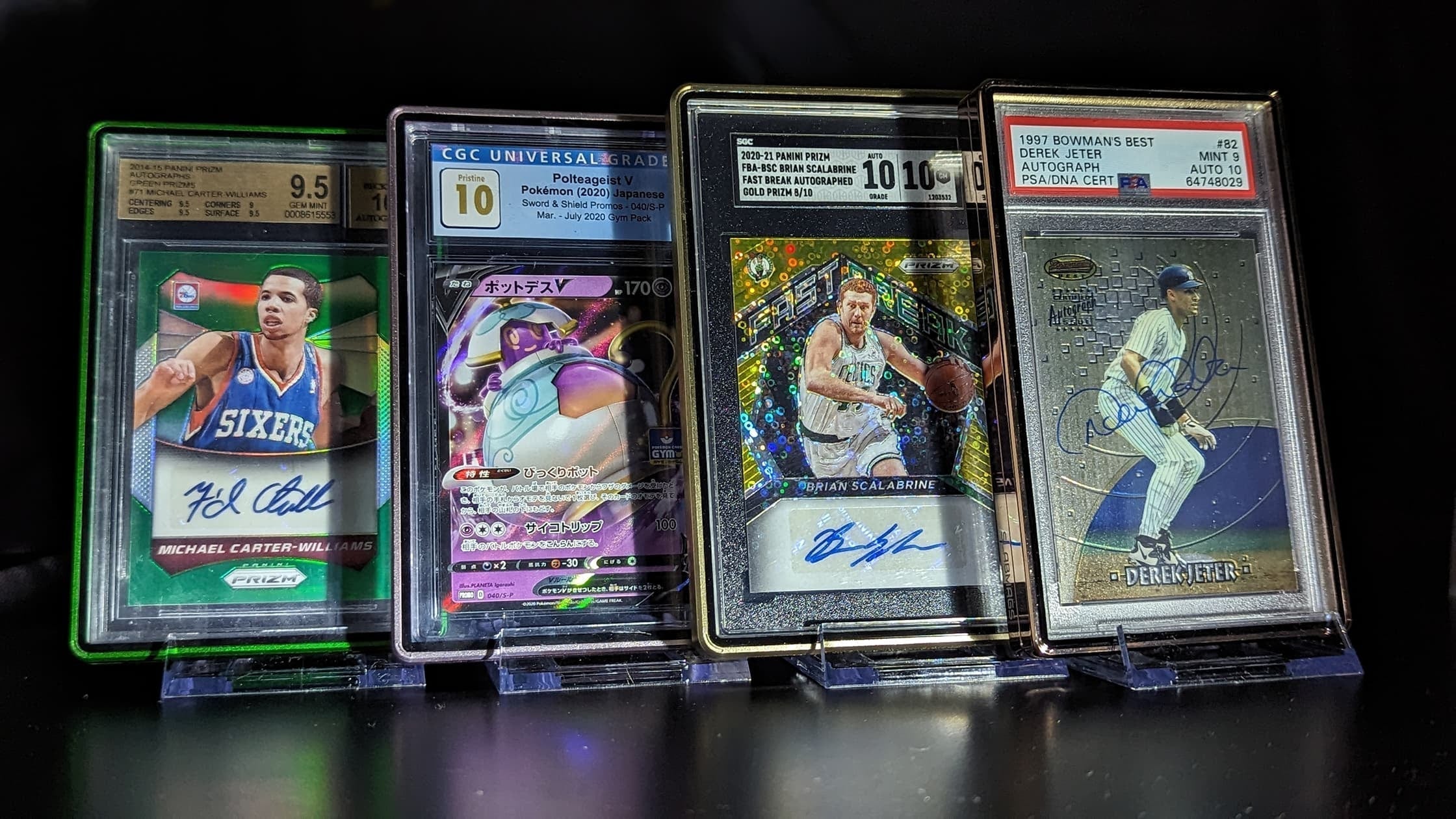
A grading company does three things: it authenticates your card, judges its condition, and then seals it in a tamper-evident plastic slab with a label showing the grade. That number becomes a shared language. A buyer in Columbus and a seller in California can agree on what “a 9” means without either of them holding the card.
Every major grader looks at the same four things:
- Centering: how evenly the borders sit left to right and top to bottom.
- Corners: sharp points versus soft, rounded, or frayed ones.
- Edges: clean lines versus chipping and whitening.
- Surface: scratches, print lines, dents, stains, and fingerprints.
Everything else in this article is a variation on those four. Master them and you’ll know most of what a grader will see before you ever pay a fee.
How to Pre-Grade Your Pulls in 5 Minutes
Before you spend a dime, play grader at your kitchen table. This free step saves more money than any other tip in this guide.
- Set the scene. Use a bright light you can angle, a clean soft surface, and a microfiber cloth. Handle the card by its edges only.
- Check centering first. Compare the left border to the right, then the top to the bottom. If one side is visibly fatter, that’s centering working against you. PSA’s published standard for a 10 is roughly 55/45 or better on the front. A card that looks fine to your eye at 60/40 can still cost you a grade.
- Inspect the corners. All four should come to a sharp point. Use a magnifier or your phone’s zoom. Any softness or white showing counts.
- Run your eyes along the edges. Whitening and tiny chips love dark borders, and they love the back of Pokémon cards.
- Tilt the surface under the light. Chrome, refractor, and foil cards hide scratches, print lines, and fingerprints until the light hits at an angle. If you can see it, the grader can too, and they have better lenses than you.
- Grade it honestly, then subtract one. Pack-fresh optimism is real. Guess the grade you think it deserves, then mentally knock it down a notch. If it still looks great, you’ve got a candidate.
One rule: never try to “clean” a card with liquids, erasers, or anything abrasive. A gentle wipe with a clean microfiber cloth is the limit. And protect your pull the moment it leaves the pack. Our guide on how to protect sports cards covers sleeves, top loaders, and storage so a great pull doesn’t pick up a scratch on the drive home.
PSA vs BGS vs SGC: The Head-to-Head
Think of the three big graders as three different judges. PSA is the famous one everybody recognizes. BGS is the one who shows their work. SGC is the speedy one with a cool black slab and serious vintage credibility. Here’s how they stack up:
| PSA | BGS (Beckett) | SGC | |
|---|---|---|---|
| Grading scale | 1 to 10, mostly whole numbers | 1 to 10 in half-point steps | 1 to 10 with half-point steps |
| Subgrades | No | Yes: centering, corners, edges, and surface shown on the label | No |
| Top grade | PSA 10 Gem Mint | BGS 9.5 Gem Mint is the everyday top; BGS 10 Pristine is rarer; Black Label means all four subgrades are 10 | SGC 10, with Pristine 10 reserved for the rarest cards |
| Resale reputation | Usually the strongest premium at the same numeric grade | Strong at the very top; a true Black Label can outsell a PSA 10 | Solid and growing; strongest with vintage; often below PSA on modern cards |
| Price and speed | Historically pricier; tiers and wait times shift with backlogs | Mid-range; varies by tier | Often the most budget- and speed-friendly of the three |
| Best for | Modern rookies, Pokémon, anything you plan to sell | Chrome and refractor-style cards, autographs, pristine-looking pulls | Vintage, budget submissions, and fast turnarounds |
PSA: The Household Name
PSA is the grader most collectors picture when they say “slabbed.” Its whole-number scale is simple, its population reports are huge, and buyers trust the label instantly. That liquidity is the point: a PSA 10 is usually the easiest graded card to sell, and collectors often cite a premium of 10 to 30 percent over the same numeric grade from other companies. The exact gap swings card by card.
The trade-off is cost and patience. PSA’s service levels, prices, and wait times change often, and the company has paused entire tiers during backlogs. There are no subgrades, so you get one number and no explanation for it.
BGS: The Show-Your-Work Grader
Beckett Grading Services is the only one of the three that prints four subgrades right on the label. That transparency is gold for chrome, refractor, and other shiny modern cards, where a 9.5 with a 10 on surface and a 9 on centering tells a buyer exactly what they’re getting. The half-point scale also means a card that just misses a top grade lands at 9 instead of dropping a full number.
Then there’s the Black Label: a card with all four subgrades at a perfect 10. It is genuinely rare, and when it lands on a great card it can outsell a PSA 10. A regular BGS 9.5 usually sells a bit below a PSA 10, so run the numbers on your specific card.
SGC: The Fast, Value-Friendly Contender
SGC built its reputation on vintage and its classic black “tuxedo” slab, and it has become a popular choice for collectors who want quicker turnaround and friendlier pricing. Its resale premium on modern cards generally trails PSA, but the gap has been narrowing as more collectors trust the label. If you’re grading a batch of mid-value cards and speed matters, SGC deserves a look.
What About CGC?
You’ll see CGC pop up in every grading debate, especially for Pokémon and budget bulk submissions. It’s another legitimate option worth comparing, particularly if low fees matter more to you than top-end resale premium. The same rule applies: check what your exact card sells for in that company’s slab before you commit.
A word on prices and wait times: every grader adjusts fees, service tiers, and turnaround as demand rises and falls. Any number we printed here would be stale by the time you finish your coffee, so always check each company’s current pricing page before you submit.
Is Grading Worth It? The Two-Minute Math
Here’s the part most collectors skip. Grading is a bet, and you should price the bet before you place it.
Step 1: Find your all-in cost. Add the grading fee, shipping both ways, insurance, and supplies. It’s always more than the sticker price on the service page.
Step 2: Look up real sold prices. Search sold listings for the exact card in raw condition and in each likely grade (say PSA 10, PSA 9, and a low-grade fallback). Use what cards sold for, not what sellers are asking.
Step 3: Weigh the outcomes. Estimate your odds of each grade, multiply by each grade’s price, add them up, and subtract your all-in cost. Compare that to what the card is worth raw. Here are two examples using made-up but realistic numbers, assuming a $55 all-in cost and odds of 30% for a 10, 55% for a 9, and 15% for a lower grade:
| Card A: mid-value pull | Card B: chase pull | |
|---|---|---|
| Raw value | $30 | $150 |
| Grade 10 / 9 / lower | $180 / $60 / $35 | $600 / $200 / $120 |
| Expected graded value | $92 | $308 |
| Minus $55 all-in cost | $37 | $253 |
| Gain versus selling raw | About +$7 | About +$103 |
Card A “wins” by roughly seven dollars, in exchange for months of waiting, a fair amount of risk, and selling fees that would eat most of the gain. Card B is a real opportunity. Same process, wildly different answer. That’s why the price of the card matters more than the excitement of the pull.
Three rules of thumb fall out of this:
- If a 9 barely beats the raw price plus your cost, you’re really betting on a 10. Be honest about your odds.
- The bigger the gap between a 9 and a 10, the more the grade matters. Wide gaps reward careful pre-grading.
- Time has a cost. Months can pass between shipping and slab, and the market can move while you wait.
Which Cards From Your Wax Are Worth Grading?
Now the question you actually came for. Whether you cracked a hobby box, a blaster, or a pile of Pokémon packs (not sure which to buy? See our breakdown of hobby box vs blaster box vs mega box), sort your pulls into three piles. Every card in the first two piles still has to pass the five-minute pre-grade test above.
Green Light: Grade It
- Star rookies in premium parallels. Refractors, silvers, and other shiny parallels of top rookies, especially when a graded copy sells for far more than raw.
- Serial-numbered cards. Low print runs plus a star name plus a clean card is the classic grading recipe.
- Rookie autographs and on-card autos. Look into each company’s autograph options when you submit.
- Short prints and rare inserts. The cards that make you stop mid-rip and say “wait, is that a…?”
- Pokémon chase cards. Illustration rares, special illustration rares, and hyper rares of fan-favorite Pokémon are the usual suspects. Check the centering and the back edges before you get excited.
Yellow Light: Run the Math First
- Base rookies of major stars. Some are worth it if the graded premium is huge; many aren’t.
- Mid-tier colored parallels and numbered cards of solid but not superstar players.
- Star inserts with decent demand but modest raw prices.
For this pile, use the Card A versus Card B math. The answer depends on the specific card, not the category.
Red Light: Leave It Raw
- Base cards of veterans, commons, and bulk.
- Most inserts worth only a few dollars raw.
- Any card with visible flaws: off-center borders, soft corners, scratched surfaces, whitened edges.
- Cards where a top grade barely moves the price. If a 10 sells for about the same as raw, you’re paying for a plastic case.
Red-light cards aren’t worthless. They’re just better off in a sleeve and a top loader, or in a binder where you can enjoy them.
Grading for Love Is Allowed
Not every card is an investment. If your kid pulled their first hit, or you landed your favorite player’s rookie, slabbing it can be a fantastic keepsake. Just be clear with yourself that you’re buying a display piece, not a profit, and don’t let the price of grading turn a fun memory into a spreadsheet headache.
How to Submit Your Cards for Grading
- Choose your grader and service level. Match the company to your card type and the tier to your card’s value and your patience.
- Create an account and start a submission. Some service levels have minimum card counts or membership requirements, so read the fine print.
- Declare value honestly. Each tier has a maximum declared value, and declaring too low can cause problems, including upcharges.
- Sleeve and pack exactly as instructed. Every company has its own holder requirements. Follow them to the letter.
- Ship with tracking and insurance. Padded box, no loose cards, and keep your receipts.
- Track your order and be patient. Then enjoy the slab reveal.
Five Grading Mistakes That Cost Collectors Money
- Grading everything. Fees add up faster than gem-mint slabs do.
- Forgetting the hidden costs. Shipping, insurance, and supplies can rival the grading fee on cheaper cards.
- Grading at the peak of the hype. A player heats up, you submit, and by the time your slab returns the buzz has cooled.
- Skipping the pre-grade. Sending a visibly off-center card and hoping for a miracle is an expensive hobby.
- Handling pulls carelessly. Sliding a card straight into a top loader can scratch the surface. Sleeve first, always.
Frequently Asked Questions
Is PSA better than BGS or SGC?
PSA usually has the strongest resale premium, so it’s often the best choice if you plan to sell. BGS wins when subgrades and Black Label potential matter, and SGC shines for vintage, speed, and value. “Better” depends on your card and your goal.
How long does card grading take?
It ranges from a few days on premium express tiers to several months on economy tiers, and the numbers change as backlogs grow and shrink. Check the company’s current turnaround estimates before you pick a service level.
What is a BGS Black Label?
It’s a BGS 10 Pristine where all four subgrades (centering, corners, edges, and surface) are also 10. It’s the rarest BGS designation, and it can command a serious premium.
Are modern base cards worth grading?
Usually not. Unless it’s a star rookie with a big gap between raw and graded prices, the fees, shipping, and wait time tend to swallow the gain.
Can I grade cards myself at home?
You can pre-grade at home to decide what to submit, but only a grading company can authenticate and slab a card. Pre-grading is a screening tool, not a guarantee.
Does Card Chase sell graded cards or offer grading?
No. Card Chase sells sealed wax only: hobby boxes, blasters, mega boxes, hangers, fat packs, and Pokémon products, with no singles and no graded slabs. We’re not a grading company either. Our job is getting you to the pull; this guide is here to help you decide what to do next.
Chase the Hits. Catch the Thrill.
Grading decisions get easier when you know what’s worth ripping in the first place. The free Card Chase App scores sealed products by expected value in Best Wax, and its Hot Singles tab tracks the cards likely to move next, so you can spot which pulls are worth a closer look. It installs right from your browser, with no app store needed.
Want to rip a few packs and put this guide to work? Check the Card Chase events page to see where the truck is headed across Cincinnati, Dayton, and Columbus.