
If you’ve been paying attention to the alternative investment world, you’ve probably noticed that sealed wax — the hobby term for factory-sealed trading card packs, booster boxes, and collector sets — has moved well beyond a childhood pastime. In 2026, the U.S. trading card market is approaching $15 billion in value, with sealed products representing one of the most compelling ways to participate in that growth.
Whether you’re a lifelong collector or a curious investor looking to diversify, this guide covers everything you need to know about investing in sealed wax sports cards and Pokémon TCG products: what to buy, what to avoid, how to store it, and how to think about long-term returns. And if you’re in Ohio, Card Chase brings the sealed product directly to you — no storefront required.
What Is Sealed Wax Investing?
“Sealed wax” refers to any trading card product that remains factory sealed and unopened — hobby boxes, booster boxes, blaster boxes, Elite Trainer Boxes (ETBs), and Ultra Premium Collections (UPCs). The investment thesis is straightforward:
- Supply is fixed. Once a print run ends, no more boxes will ever be made.
- Demand often grows as nostalgia drives former collectors back to the hobby and new collectors enter the market.
- Sealed products preserve authenticity. Unlike individual cards, a sealed box cannot be tampered with, altered, or faked — keeping its collectible value completely intact.
Unlike single cards, which can be reprinted or lose relevance when a player retires, a sealed box is a “time capsule.” It offers exposure to the entire roster of potential hits inside without ever cracking it open.
Why the Market Is Thriving in 2026
The trading card renaissance of the early 2020s has matured into a robust, recognized alternative asset class. Here’s what’s driving the market right now.
A Massive and Growing Industry
The sports trading card market was valued at approximately $12.6 billion in 2024 and is projected to reach over $23 billion by 2032, growing at a compound annual growth rate (CAGR) of roughly 7.8%. The broader collectibles and memorabilia space — including graded cards, sealed products, and game-worn memorabilia — could approach $271 billion by 2034 if some industry projections hold.
The License Shuffle Effect
One of the biggest investment storylines of 2025–2026 is the Panini-to-Fanatics/Topps license transition in football. With Panini’s NFL license expiring, 2025 Prizm, Phoenix, Absolute, and Optic football boxes represent the last officially licensed Panini NFL products ever made. Historically, when major manufacturers lose licenses, their sealed product values appreciate significantly once the supply clears and collectors recognize those products are truly gone for good.
Catch us at our next Ohio event to get your hands on these transitional Panini products while they’re still available — inventory is tightening fast.
Newcomer Demand Is at Record Highs
Card shows are more popular than ever, live-breaking platforms like Whatnot and Fanatics Live have turned box openings into a spectator sport, and social media has created a new generation of collectors discovering both the hobby and the investment angle simultaneously.
Sports Cards Sealed Wax: What to Buy (and What to Avoid)
Not all sealed wax is created equal. Here’s a sport-by-sport breakdown of where smart money is focused in 2026.
Football
The most significant opportunity right now revolves around the Panini license transition. Boxes from 2025 Prizm, Phoenix, Absolute, and Optic are loaded with rookie autos and memorabilia from a standout class including Cam Ward, Travis Hunter, Jaxon Dart, and Ashton Jeanty. Once Fanatics/Topps takes over NFL production, sealed values on these sets are widely expected to climb — mirroring what happened when Topps lost its MLB license in 2022.
What to look for: Hobby boxes (not retail blasters) of premium Panini sets with guaranteed autographs. Hobby boxes offer significantly better odds on high-value hits and are the format serious investors target.
What to avoid: Retail mega boxes and blasters. While affordable and accessible, their print runs are enormous and the odds on meaningful hits are poor — making them entertainment products, not investment vehicles.
Baseball
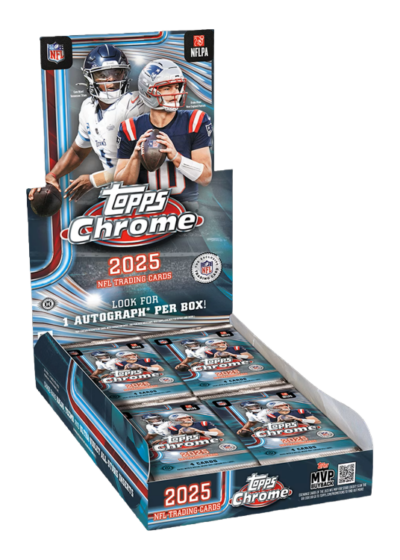
Baseball collectors have one of the strongest rookie classes in years. 2025 Bowman Draft is the key product — featuring top prospects including the No. 1 overall pick alongside high-upside pitchers. Bowman and Bowman Chrome are the gold standard for first autographs of prospects, and a breakout player from the 2025 draft class could make a sealed hobby box worth multiples of its original price. Topps Chrome Baseball also consistently ranks among the most valued annual releases for long-term sealed holds.
Basketball
2025-26 Topps Chrome Basketball is the standout product of the current cycle, driven by one name: Cooper Flagg. First-year NBA products featuring generational prospects tend to age exceptionally well in sealed form, and the market is still adjusting to Fanatics’ control of the NBA license — which can create pricing inefficiencies for savvy buyers.
A Note on Overproduction Risk
It would be irresponsible to cover sealed wax investing without addressing the biggest risk in the current market: overproduction. Some modern NBA flagship products have seen over 429 million cards printed, with more than 1.26 million copies of each base card. The takeaway: stick to hobby-exclusive products, prioritize sets with known print-run controls, and avoid mass-retail products for investment purposes. Base cards and common inserts in overproduced sets hold almost no resale value.
Pokémon TCG Sealed Wax: The Alternative Investment Powerhouse
If sports cards are the established investment, sealed Pokémon TCG is the rocket ship. No other trading card product has produced the documented return multiples of sealed Pokémon booster boxes — and the data is hard to argue with.
The Numbers Don’t Lie
A sealed Evolving Skies Booster Box could be purchased for around $200 shortly after its 2021 release. By early 2026, that same box was commanding prices north of $2,600 — a return of over 1,200% in roughly four years.
Going further back, a Base Set Unlimited Booster Box — the original 1999 Pokémon release — is currently valued between $20,000 and $25,000 in near-mint condition, representing 300–400% appreciation over just the last five years. A Base Set 2 Booster Box now commands $8,000–$10,000 with similar trajectory. These aren’t isolated cases.
Why Sealed Pokémon Works as an Investment
Generational nostalgia with money. The original Pokémon fans from the 1990s are now adults with significant disposable income, and their demand for sealed vintage product is relentless.
Supply only shrinks. Every time someone opens a sealed box, total supply decreases permanently. Once a set goes out of print, that’s it — and prices reflect that reality over time.
Price floors establish themselves. Once a sealed box crosses certain price thresholds — $500, $1,000, $2,000 — it tends to maintain at least that level regardless of short-term market sentiment. This gives investors a degree of downside protection not found in many collectibles.
Global demand. Unlike some sports cards that are region-specific, Pokémon is a global brand with passionate collector communities in Japan, Europe, North America, and beyond — meaning your exit market is enormous.
Which Pokémon Sets to Target in 2026
For long-term holds (5+ years):
- Evolving Skies — Already appreciating sharply; the beloved Eevee set has massive cross-demographic collector appeal
- Scarlet & Violet 151 — The Base Set throwback has cult status among nostalgic collectors
- Brilliant Stars — Charizard VSTAR chase card drives sustained demand
- Any out-of-print Sword & Shield era hobby products — supply is finite and drying up fast
For medium-term holds (2–3 years):
- Prismatic Evolutions — ETBs and sealed products from this set are already showing strong early appreciation
- Ascended Heroes (2026) — Early Q1 2026 data shows strong sealed gains in this Mega Evolution block
Keep an eye on anniversary products. The upcoming Pokémon 30th Anniversary product lineup is generating enormous pre-market buzz. The 25th Anniversary “Celebrations” products saw 300%+ gains on certain items — a 30th anniversary set tied to Pokémon’s milestone could be one of the single best sealed investment opportunities in years.
Pro tip: English-language boxes typically outperform Japanese boxes for sealed investment purposes due to stronger appreciation curves and larger Western secondary market demand.
Booster Boxes vs. ETBs vs. UPCs: Which Format to Buy?
Booster Boxes (36 packs) are the undisputed king for long-term sealed investment. They offer the best price-per-pack efficiency, the most recognized format on the secondary market (easiest to sell), and the most consistent historical appreciation. If you’re investing in sealed Pokémon, start here.
Elite Trainer Boxes (ETBs) are more affordable entry points. Certain ETBs from beloved sets have seen strong appreciation, and they lower the barrier to getting started. However, they’re less liquid than booster boxes and track records vary more widely by set.
Ultra Premium Collections (UPCs) are the highest-upside format — but also the most volatile. Limited print runs mean they can skyrocket or stay flat depending on collector sentiment. Best for experienced investors who know the specific set’s demand profile.
At Card Chase, we stock a rotating selection of sealed Pokémon products and sports hobby boxes. Browse our current sealed inventory or find us at our next Ohio event to see what we’ve got in person.
How to Store Sealed Wax the Right Way
Sealed wax investing only works if you protect what you’re holding. Poor storage is one of the most common ways collectors destroy the value of their sealed product.
Climate Control Is Non-Negotiable
The ideal environment for storing sealed trading card products:
- Temperature: 65–72°F (18–22°C) — stable, never fluctuating
- Humidity: 45–55% relative humidity
Temperature swings and humidity are the twin enemies of any paper-based collectible. Humidity above 60% causes warping, mold, and adhesion between cards. Below 30–35%, cards become brittle and prone to cracking. Invest in a digital hygrometer (available for under $15) to monitor conditions year-round.
Avoid basements, attics, and garages. These spaces experience the most dramatic temperature and humidity swings, even in otherwise stable climates. A climate-controlled interior room — or a dedicated climate-controlled storage unit for larger collections — is the right choice.
Protect the Box Itself
For sealed wax, the outer box is part of the asset. A crushed corner or water-damaged box will reduce resale value even if the sealed packs inside are untouched. Best practices:
- Acid-free storage boxes or plastic bins with snap-on lids (not fully airtight — allow some ventilation)
- UV-protective environments — direct sunlight fades box art, reducing collectibility
- Silica gel packets placed near storage areas to manage ambient moisture
- Careful stacking to prevent compression damage on corners
Insurance and Documentation
For collections worth $5,000 or more, collectibles insurance is worth serious consideration. Standard homeowner’s policies typically exclude or severely limit coverage for collectibles. Keep purchase receipts, photos, and an inventory spreadsheet of every sealed item you own — critical for insurance claims and tracking your cost basis when you eventually sell.
The Risks Every Sealed Wax Investor Needs to Understand
Sealed wax investing can generate impressive returns — but it carries real risks that every investor should understand before committing capital.
Overproduction risk is the most significant threat in the modern market. When manufacturers print too heavily, values stagnate for years. Research print runs and stick to hobby-exclusive products.
Condition risk is real even for sealed boxes. A sealed box stored in poor conditions, with a damaged outer box, or showing signs of tampering is worth far less than a pristine example. Buy from reputable sources and store correctly from day one.
Liquidity risk — unlike stocks, you cannot sell sealed wax with a single click. Selling takes time, platform fees (eBay charges 13%+), and the right buyer. Build these friction costs into your return calculations upfront.
Market sentiment risk — collectibles markets are driven by sports performance, pop culture, and nostalgia cycles. A star athlete’s injury or retirement can crater the value of products tied to them. Diversification across sports, athletes, and eras helps manage this.
Authentication risk — counterfeiting sealed wax does exist, particularly for high-value vintage Pokémon products. Always buy from trusted hobby shops or established dealers. Card Chase carries only authentic, verified sealed product — no grey-market boxes, ever.
Building a Sealed Wax Portfolio: Practical Tips
Start with what you know. If you grew up a baseball fan, start with baseball. Passion for the product makes research easier and helps you spot opportunities others miss.
Set a budget and stick to it. Sealed wax investing works best as a medium-to-long-term hold (3–10 years). Only invest capital you won’t need in the short term.
Diversify across formats. A balanced portfolio might include a few sports hobby boxes, a couple of Pokémon booster boxes from different eras, and one or two limited-edition special products.
Buy at or near MSRP when possible. The best returns come from buying sealed product at or below retail price and holding. Buying heavily marked-up secondary market boxes compresses your potential upside significantly.
Track the market regularly. Platforms like eBay (completed sales), PWCC Marketplace, Goldin, and dedicated Pokémon pricing trackers give you real-time data on what sealed products are actually selling for — not just asking prices.
Consider grading for your opens. If you ever open sealed product, submitting high-grade cards to PSA, Beckett (BGS), or CGC can significantly amplify a chase pull’s value. A PSA 10 or BGS 10 grade can multiply a card’s raw value by 50–200%.
The Bottom Line
Sealed wax investing sits at a rare intersection: a market with genuine collector passion, demonstrable historical appreciation, finite supply, and increasing mainstream awareness. Whether you’re drawn to the thrill of a sealed sports card hobby box or the long-term track record of Pokémon booster boxes, there’s real opportunity here for investors willing to do their homework.
The key is strategy over impulse. Focus on hobby-grade products, prioritize sets with limited print runs and strong collector demand, store your investments properly, and think in years rather than months.
The $15 billion trading card market isn’t going anywhere — and the collectors who get in thoughtfully, protect their assets, and hold patiently are the ones who come out ahead.
Ready to start your sealed wax portfolio? Explore Card Chase’s current sealed inventory, check out where we’ll be next across Cincinnati, Dayton, and Columbus, or reach out to our team with any questions — we’re passionate collectors and investors ourselves.
Frequently Asked Questions
Is sealed wax a good investment in 2026?
Yes — for the right products. Focus on hobby-exclusive boxes with controlled print runs, strong rookie classes in sports, or proven collector demand like Pokémon vintage sets. Avoid mass-retail overproduced products.
What’s the difference between a hobby box and a retail blaster?
Hobby boxes are sold exclusively through hobby shops and offer significantly better odds on autographs, relics, and rare parallels. Blasters are mass-retail products (Target, Walmart) with far higher print runs and lower hit rates — better for entertainment than investment.
How long should I hold sealed wax?
Most sealed wax appreciates most meaningfully over 3–10 years. Short-term flipping is possible on high-demand releases, but the biggest gains historically come from patient, long-term holds.
Where is the safest place to buy sealed wax?
Authorized hobby shops, reputable online dealers with verified seller ratings, and established auction houses (Goldin, PWCC, Heritage Auctions) are the safest sources. Card Chase carries only authenticated sealed product across our Ohio events.
Can Pokémon cards really be worth thousands?
Yes — and the data backs it up. Sealed vintage Pokémon booster boxes have produced some of the most dramatic appreciation rates of any collectible asset class in the last decade, with examples like Evolving Skies returning over 1,200% since 2021.
Want to stay ahead of new releases and sealed investment opportunities? Follow the Card Chase blog for regular market updates, product reviews, and event news from Ohio’s favorite mobile card shop.