Quick Answer
To find out how much your sports cards are worth, identify the exact card (year, brand, set, card number and any parallel or serial number), then look up recent sold prices for that same card in the same condition. Use eBay’s Sold Items filter or 130point, never asking prices. The biggest value drivers are the player, rookie status, scarcity, autographs or relics, and condition.
Maybe you found a binder in your parents’ basement. Maybe you just pulled something shiny out of a pack at the Card Chase truck. Either way, the first question is always the same: is this worth anything?
The good news is you don’t need to pay anyone or buy a book to find out. In about ten minutes you can get a realistic value for almost any card. This guide walks you through the exact steps, the free tools collectors use, what makes a card valuable, and the mistakes that trip up most beginners.
Step 1: Identify the Exact Card
Two cards of the same player can be worth wildly different amounts, so start by writing down exactly what you have. Most of this is on the back of the card:
- Year and brand. For example, 2026 Topps or 2025-26 Topps Chrome.
- Set name. Flagship, Chrome, Bowman, Heritage, Prizm and so on.
- Card number. Printed on the back, usually in a corner.
- Parallel or color. A gold border, a refractor shine or a colored pattern can mean it’s a parallel, which is often worth more than the base card.
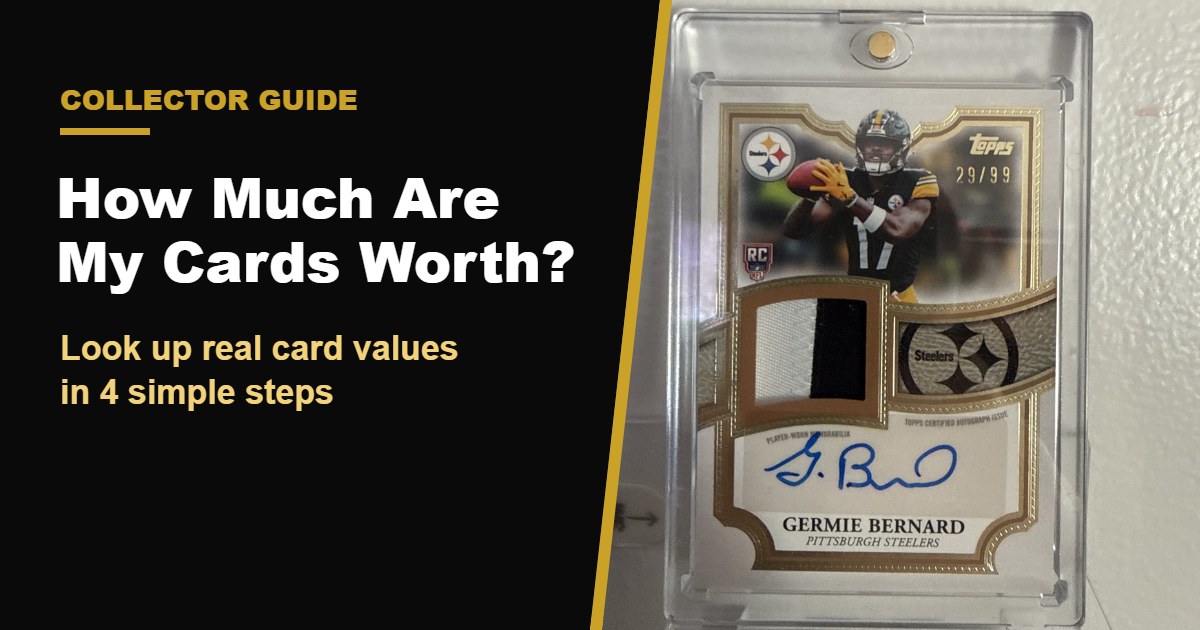
- Serial number. A stamp like 25/99 means only 99 copies exist.
- Special features. An autograph, a piece of jersey (a relic or patch), or an RC logo for a rookie card.
Not sure what a parallel, refractor or relic is? Our blog has guides that explain the hobby’s terms in plain language.
Step 2: Look Up Sold Prices, Not Asking Prices
This is the most important rule in card values. Anyone can list a card for any price. What matters is what buyers actually paid.
eBay sold listings
Search eBay for your exact card, then turn on the Sold Items filter (on a phone, it’s under Filter; on a computer, scroll down the left side). Green prices are completed sales. Look at the last several sales, not just one.
130point
130point is a free search site that pulls eBay sold data and shows the real price when a seller accepted a Best Offer. eBay hides that number and shows the original list price instead, so 130point often gives a truer picture.
Price guides and auction records
Grading companies publish sales records for graded cards, like PSA’s Auction Prices Realized. Paid tools such as Card Ladder and Market Movers chart sales over time. Printed price guides are a fine starting point, but their numbers often lag behind real sales.
Step 3: Compare Like With Like
A sale only tells you something if it’s the same card in the same condition. Watch for these common mismatches:
- Raw vs graded. A card in a PSA, BGS or SGC slab with a high grade can sell for many times the price of an ungraded (raw) copy. Don’t compare your raw card to graded sales.
- Different grades. A PSA 10 and a PSA 9 of the same card can be far apart in price.
- Base vs parallel. Make sure the color and numbering match yours exactly.
- Lots and bundles. Skip sales that include several cards.
- Outliers. Ignore one wild sale that’s far above or below the rest.
Step 4: Be Honest About Condition
Condition is where most people overestimate. Hold the card under a bright light and check four things:
- Centering. Are the borders even on all sides?
- Corners. Are they sharp, or soft and rounded?
- Edges. Any white chipping or roughness?
- Surface. Look for scratches, print lines, dents or stains.
A card with soft corners or a crease is worth a fraction of a clean copy. If your card isn’t close to perfect, compare it to raw sales or lower grades, not PSA 10s.
What Makes a Sports Card Valuable?
| Factor | Why it matters |
|---|---|
| The player | Stars, Hall of Famers and hot young players drive demand. |
| Rookie card | A player’s first-year cards, marked RC, are usually his most collected. |
| Scarcity | Serial-numbered parallels, short prints and 1/1s are rarer than base cards. |
| Autographs and relics | On-card autographs and patch cards add value, especially for rookies. |
| Condition | Clean, well-centered cards are worth far more, and grading can add a premium. |
| Era | Cards from about 1987 to 1994 were mass-produced, so most are worth little. |
| Timing | Values rise and fall with a player’s performance, injuries and big moments. |
What About Old Cards From the 80s and 90s?
This is the question we hear most at the truck. Cards from roughly 1987 to 1994 are known as the junk wax era, because card companies printed so many that most will never be scarce. A full box of base cards from that era often isn’t worth much.
There are still gems: key rookie cards of Hall of Famers in top graded condition, famous error cards, and the early inserts and parallels that started appearing in the 1990s. Older vintage cards from the 1950s through the 1970s can be valuable too, especially stars and rookies in good shape.
Common Mistakes When Pricing Cards
- Using asking prices instead of sold prices.
- Comparing a raw card to graded sales.
- Missing that a sale was a different parallel or serial number.
- Assuming a card is mint because it came straight from a pack. Many cards have flaws from the factory.
- Forgetting fees. Selling platforms and shipping take a cut of the sale price.
Should You Grade It?
If your card is a desirable player, looks clean under a light, and the graded sales are well above the raw price plus the grading fee, grading can make sense. For most cards, it doesn’t. Our guide to which cards are worth grading walks through a five-step check with a free calculator, and our PSA vs BGS vs SGC comparison helps you pick a grading company.
Protect it first
Whatever it’s worth, put any card you care about in a penny sleeve and a top loader. Here’s our complete guide on how to protect sports cards.
Chase Your Next Valuable Card at the Card Chase Truck
The fun part of the hobby is pulling the next card worth looking up. The Card Chase truck brings sealed sports cards and Pokémon to card shows and events around Cincinnati, Dayton and Columbus, and you can rip your packs right at the window. See what’s on the truck, check the free Card Chase App for our score on every box, and find our next stop on the events page.
Frequently Asked Questions
How do I find out what my sports cards are worth?
Identify the exact card (year, brand, set, card number and any parallel or serial number), then search recent sold listings for that exact card in the same condition or grade. eBay’s Sold Items filter and 130point are the most common free tools. Asking prices don’t count. Only completed sales show real value.
Are old baseball cards from the 1980s and 1990s worth money?
Most cards from about 1987 to 1994, often called the junk wax era, were printed in huge numbers and are worth very little. The exceptions are key rookies of Hall of Fame players in top graded condition, rare errors, and some inserts and parallels.
Is a price guide like Beckett accurate?
Printed price guide values are a useful starting point, but they often lag behind the market. Recent sold prices for the exact card and condition are a more accurate measure of what a buyer will pay today.
Does grading make a card worth more?
Grading can add a big premium to a desirable card in top condition, especially a PSA 10. For most cards, the grading fee is more than the value it adds. Check the sold prices for raw, PSA 9 and PSA 10 copies before you pay to grade.
Why are some cards numbered, like 25/99?
A serial number shows how many copies of that card exist. A card numbered 25/99 is the 25th of 99 copies. Lower print runs, especially 1/1s, are rarer and usually more valuable than base cards of the same player.

Written by
Greg Little · CEO
Greg is the CEO of Card Chase. He covers new releases, box value, rookie cards and the sports card market.

